On storytelling, memory, failure, and the art of not knowing what happens next. My research begins with a fairly simple suspicion: we learn as much from the stories that fall apart as we do from the ones that hold together. Across theatre, film, archival research, and experimental teaching, I explore storytelling as an act of memory, failure, survival, and belonging. I am particularly interested in what happens when narratives resist mastery, when expectations collapse, and when the things we cannot control become the most interesting parts of the story. Sometimes this means digging through archives. Sometimes it means writing about movies. Sometimes it means asking a room full of college students to attempt something they are almost certain to fail. All of it begins with curiosity.
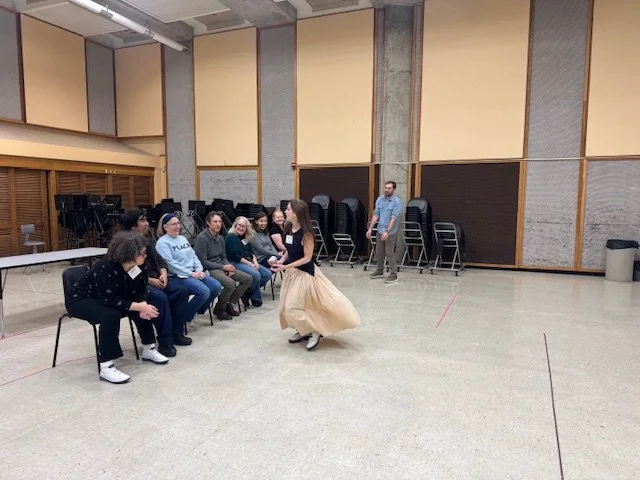
The Theatre of Failure Lab: Speculative Performance and the Art of the Possible at a2ru’s Creative Futures Conference, University of Wisconsin-Madison, 2025.
The Kobayashi Maru, or The Art of Failure
What if learning how to fail is one of the healthiest things we can teach?
Named after the famously unwinnable training exercise in Star Trek, The Kobayashi Maru, or The Art of Failure is an experimental honors seminar I developed at St. Edward's University. The course begins with a question that higher education doesn't always know how to answer: What happens when success is not the point? Students explore failure through storytelling, creative experiments, impossible problems, collaboration, and reflection. Rather than treating mistakes as evidence of inadequacy, we examine them as opportunities for discovery, resilience, ethical decision-making, and personal growth. The course challenges a familiar assumption about education: that learning is primarily about demonstrating mastery. Instead, students practice uncertainty, take creative risks, confront their expectations, and discover that not knowing what to do next can be a remarkably productive place to begin. This work has become the foundation for my ongoing research into failure as a creative methodology and a practice of human flourishing.
In 2025, I presented The Theatre of Failure Lab: Speculative Performance and the Art of the Possible at a2ru's Creative Futures Conference at the University of Wisconsin–Madison. The interactive laboratory invited participants to experience failure not as an endpoint, but as an artistic and pedagogical tool. In fall 2026, I am returning to a2ru's conference at the University of Memphis with Sarah O'Connell to present: The Kobayashi Maru Classroom: Teaching Failure, Creative Risk, and Human Flourishing, or Why a Course Devoted to Mistakes Might Be One of the Healthiest Things Happening in Higher Education.
The argument is not simply that failure is good for us. It is that higher education has become extraordinarily skilled at measuring achievement while sometimes forgetting to teach students how to live with uncertainty. The arts offer something essential: a place to rehearse the unexpected, practice vulnerability, and discover that resilience is something we develop through experience. Failure, in this work, is not the destination. It is the medicine.
Slow(ness), or The Paradox of Time
An experiment in attention, memory, and the radical act of slowing down. Developed and taught in collaboration with artist Alexandra Robinson, Slow(ness), or The Paradox of Time was an experimental honors seminar exploring our relationships with time, attention, memory, and place. Students investigated what happens when we deliberately resist the demands of speed and productivity. Through sound collection, walking, observation, creative research, and collaborative making, they experimented with new ways of experiencing and documenting the world. The course treated attention as a creative practice and slowing down as an act of discovery. In a culture increasingly organized around efficiency, the experiment asked whether doing less might allow us to notice more.
Archives, Cinema, and the Stories We Tell About Ourselves
My developing archival research at the Harry Ransom Center investigates how filmmakers, screenwriters, and producers use cinema as a form of personal mythmaking and self-interrogation. Through production archives, drafts, correspondence, and ephemera, I am interested in the distance between the story an artist intends to tell and the story that eventually emerges. What gets abandoned? What survives revision? What happens when practical constraints, artistic disagreements, or personal circumstances fundamentally change a work? These questions place failure, revision, and creative uncertainty at the center of artistic production. Rather than treating unfinished drafts and discarded ideas as historical footnotes, I examine them as evidence of how artists think, struggle, and reinvent themselves. Sometimes the most revealing story is the one that never made it to the screen.
Popular Culture as Modern Mythology
I also write about contemporary cinema and popular culture, particularly the ways familiar genres carry unexpected emotional, ethical, and rhetorical weight. My essays have explored violence as rhetoric in the John Wick films, John Williams as the unseen narrator of modern cinema, and Aca-Feminism: Why Pitch Perfect Is an Important Feminist Story of a Generation. I approach popular culture as a form of modern mythology, a place where our ideas about heroism, grief, devotion, gender, faith, violence, and love are continually rehearsed and revised. A blockbuster can be a philosophical argument. A musical comedy can be a feminist text. A film score can tell a story the characters themselves do not understand. Sometimes the most important cultural conversations are happening in the places we have been taught not to take seriously.
New Plays, Uncertain Futures, and Other Experiments
My creative writing investigates many of these same questions through theatrical and cinematic forms. My recent play, The Last Love Letter In The World, at The Holistic Phenomenology of The Happiest Place on Earth at 2:14 a.m.,* or Maybe Tomorrow* follows a couple navigating life in the shadow of ALS. The work explores intimacy, time, humor, and the complicated negotiations of care without insisting that love can resolve everything.
My short screenplay, Teenagers Laying on the Floor of the IKEA Showroom, is, more or less, exactly what it sounds like. Both works are interested in people attempting to love one another in circumstances they cannot entirely understand or control. They ask how storytelling might make room for uncertainty without demanding resolution.
Immersive Theatre and the Architecture of Belonging
My recent essay, Everyone Is Invited (Some Assembly Required), or The Myth of Total Freedom in the Architecture of Belonging, explores immersive theatre, participation, and the invisible rules that determine who feels welcome inside an experience. Drawing on immersive performance, popular culture, and classroom experiments, the work investigates the difference between being permitted to enter a space and genuinely belonging within it. Immersive experiences frequently promise freedom, agency, and participation. But those promises are shaped by hidden expectations, social codes, physical environments, and unequal access to information. This inquiry connects my research on performance and audience engagement with broader questions about education, inclusion, and the stories institutions tell about themselves.
The Art of the Unfinished
Across these projects, I return to a shared conviction: stories matter not because they provide perfect answers, but because they help us live with imperfect ones. Whether I am working with archival materials, developing a play, examining a popular film, or designing a classroom experiment, I am interested in what happens when certainty gives way to possibility. The most meaningful discoveries are not always the ones we set out to make. Sometimes the experiment fails. Sometimes the story changes. Sometimes that is where the real work begins.