My teaching is rooted in problem-based learning and experiential design. I treat the classroom as a laboratory for creative risk, where students learn by doing, writing, performing, analyzing, revising. Each course I teach requires students to take an active role in their own creative growth. I guide them through projects that challenge assumptions, frame creative problems, and build collaborative teams. I believe in meeting students where they are, both intellectually and technologically; I regularly use tools like discussion boards, social media, and visual platforms to extend the classroom beyond its walls and into the communities where their stories resonate.
Whether I am teaching playwriting, screenwriting, or creative writing at the introductory level, I aim to design courses that blend theory with practice. I often assign unconventional texts, Albert Camus’ Notebooks, Kurt Vonnegut’s “Bagombo Snuff Box,” or Charlie Chaplin films, not simply for what they say about writing or performance, but for how they model structure, tone, and discipline. Alongside these, I incorporate contemporary models of adaptation, such as the works of Charles L. Mee, as well as classical sources. This cross-temporal, interdisciplinary approach helps students understand that structure is fluid, voice is earned, and art is always in conversation with history.
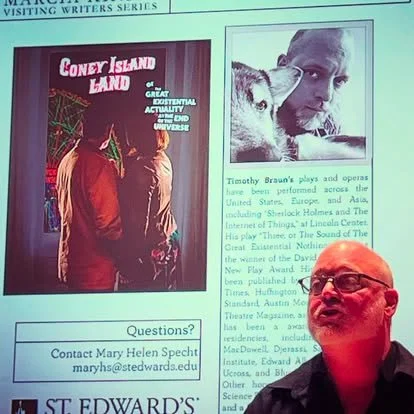
The Marcia Kinsey Visiting Writers Series at St. Edward's University, 2025
In directing student work, I focus on ensemble-driven processes and horizontal criticism. My goal is not to shape students into “correct” playwrights or screenwriters, but to help them become more honest, more disciplined, and less wrong in their creative choices. We work together to develop a vocabulary of curiosity, rigor, and respect. I often reference Aristotle’s Poetics, Pixar’s rules for storytelling, and Patton Oswalt’s Montreal Address to help students locate their voices, and more importantly, to understand the context of those voices in collaborative and cultural spaces.
Teaching in a liberal arts environment has shown me that students thrive when challenged to synthesize artistic form with ethical inquiry and personal identity. At St. Edward’s University, I have mentored students from their first year to capstone, and beyond, supporting LGBTQ+, Latino, African American, and first-generation students as they move toward graduate study, publication, or professional creative work. This mentorship reflects my belief that creative writing is not simply an academic subject but a practice of resilience and belonging. As Oscar Hammerstein once said, “Through your students, you will learn.” That is not just a philosophy but the reason I teach.
Signature Courses
Every classroom is an experiment. Some involve plays. Some involve impossible problems. Most involve discovering that the rules are not quite what we thought they were.
The Kobayashi Maru, or The Art of Failure An experimental honors seminar inspired by Star Trek's famously unwinnable scenario. Students investigate failure, resilience, creative risk, and the strange possibility that learning how to lose might be one of the most important things a university can teach.
Slow(ness), or The Paradox of Time Co-taught with artist Alexandra Robinson, this honors seminar asks students to reconsider their relationship with time, attention, and place. Through walking, listening, observation, and creative experiments, students discover what happens when slowing down becomes an act of making.
Playwriting A hands-on exploration of dramatic writing in which students build characters, create conflict, break structures, and discover how stories come alive through performance. From ten-page plays to collaborative experiments, the classroom becomes a workshop where nothing is quite finished until someone else reads it aloud. This course includes an introduction to Fornés technique.
Stage and Screenwriting An exploration of storytelling across theatre, film, and television, examining how narratives change when they move between mediums. Students write, adapt, experiment, and discover that what works beautifully on a stage might be a disaster on a screen, and vice versa.
The Play Is the Thing A first-year seminar that uses theatre, storytelling, performance, and popular culture to investigate identity, community, and the stories we tell about ourselves. Students encounter plays, create original work, and learn that a classroom can be both an intellectual laboratory and a place to belong.
DIY Dramatic and Visual Writing A creative laboratory devoted to building stories across forms, including scripts, visual narratives, and experimental projects. Students explore what happens when the boundaries between writer, performer, designer, and audience begin to disappear.
Austin's Storytelling Culture An investigation of Austin as a living archive of stories, performances, places, and communities. Students explore how a city tells its own story, who gets to participate in that telling, and what happens when its competing narratives collide.
World Building Designed for emerging visual storytellers and game creators, this course explores the architecture of imaginary worlds, from their histories and cultures to their conflicts and unwritten rules. Students learn that a believable world is not simply a place where a story happens, but a place capable of generating stories of its own.
Theatre History I and II An exploration of theatrical traditions across cultures and centuries, from ancient performance to contemporary experimentation. Through creative research, historical investigations, and projects that invite students to steal, adapt, and reinvent theatrical conventions, history becomes something students actively make rather than simply memorize. This leads to The Theatre History Project a growing collection of interactive websites that bring theatrical traditions, artists, and movements from across centuries and cultures to life. Designed as creative laboratories rather than digital textbooks, these experiments invite students to explore, question, and discover that theatre history isn't something we simply study. It's something we continue to make. For each Unit I have built a four-tiered interactive website you can find after this picture of a student during then Commedia dell’arte unit:
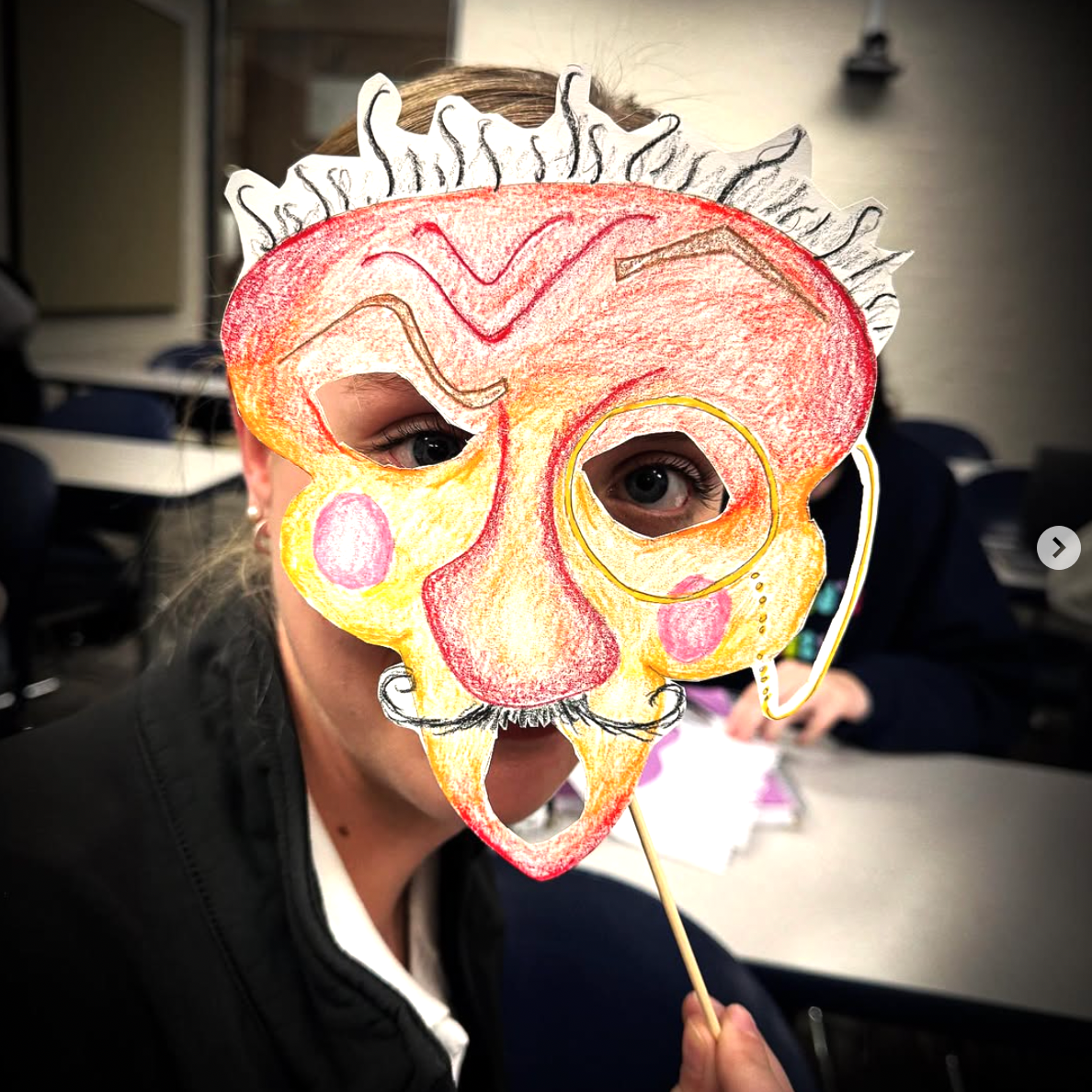
Teaching Commedia dell’arte and archetypal characters in modern society with building masks from the prompts “Delivering a secret message”, “Falling in love,” and “dodging taxes” is à propos on this Election Day, 2025.
Click the title of the unit, and you will be magically transported to the corresponding website
Theatre History I
Unit 4: The Greeks and Romans: Tragedy, Comedy, and the Birth of Spectacle From Aristotle's theories of tragedy to the theatrical entertainments of Rome, we examine how performance became a space for politics, philosophy, laughter, and public identity.
Theatre History II
Unit 6: Theatre as a Weapon: Brecht, Artaud, and Political Performance Through Bertolt Brecht's Epic Theatre, Antonin Artaud's Theatre of Cruelty, and other radical experiments, we investigate theatre's power to challenge audiences, confront ideology, and disrupt the comfortable relationship between performer and spectator.
Unit 9: The Revolution Will Be Performed in a Basement: Off-Off-Broadway and Experimental Theatre, or The Lunitics Have Taken Over the Theatre. No Money. No Problem From the Caffe Cino and La MaMa to the Living Theatre, the Open Theater, and the Wooster Group, we explore how artists rejected commercial conventions and reinvented the possibilities of performance, collaboration, and theatrical space.