I describe my creative aesthetic as American Baroque: character-driven storytelling that begins in emotional realism and then bends, fractures, and reconfigures the world around it. My work typically starts with an organic, character-based narrative rooted in contemporary concerns, grief, memory, intimacy, failure, and builds outward, shaping environments that reflect the psychological and emotional needs of the characters themselves. These worlds are then stretched, distorted, and heightened, like reflections in a funhouse mirror, allowing the familiar to coexist with the fantastic. I am interested in grounding audiences in recognizable human experience while creating enough aesthetic and structural distance to invite reflection, participation, and play.
Across media, my work is deeply invested in structure, shape, and the expressive use of time and space. Whether writing for the stage, screen, or hybrid forms, I treat storytelling as an architectural process: narratives unfold according to rules, rhythms, and constraints that shape how meaning is received. This approach naturally aligns my work with immersive and interactive storytelling traditions, including gaming logic, world-building, and site-responsive design. I am especially drawn to environments where space itself becomes narrative, subway cars, bathtubs, elevators, black box theaters, and nontraditional venues, sites that foreground audience presence and destabilize passive spectatorship.
My work has been presented at a wide range of theaters and festivals, including Lincoln center, The Come Out and Play Festival in both NYC, and San Fransisco, La MaMa ETC, HERE Arts Center, The Flea, Ensemble Studio Theatre, Bowery Poetry Club, Salvage Vanguard, the New York International Fringe Festival, Seattle Fringe Festival, The Howl Festival, and The Re/Mix Festival. These contexts have allowed me to test narrative forms in spaces that encourage risk, experimentation, and interdisciplinary collaboration, values that also animate contemporary platforms such as SXSW and institutions invested in cross-media storytelling and innovation. In each setting, I approach storytelling not as a fixed form, but as a responsive system shaped by audience, environment, and technology.
In recent years, my creative research has become increasingly meta-theatrical and self-reflexive, asking foundational questions such as: What is theatre? What is play? How does live storytelling function in a digitally saturated world? These questions have led me to experiment with podcasts, site-specific performance, and hybrid narrative delivery, often embracing productive failure as part of the research process. I am particularly interested in the convergence of live performance, social media, and digital storytelling, and how liveness, interactivity, and networked audiences reshape authorship, presence, and meaning.
This inquiry naturally connects my work to interactive and game-informed storytelling, where choice, agency, and rule-based systems complicate traditional narrative structures. I am less interested in technology as spectacle than as a storytelling partner, one that invites ethical, emotional, and experiential questions about participation and control. As a result, my practice frequently involves collaboration with artists across disciplines, including musicians, designers, choreographers, animators, and media artists, allowing narrative to emerge through collective process rather than a single dominant form.
At its core, my work asks what comes next for the storyteller: how writers can remain responsive, imaginative, and human in an era of rapid technological change. Whether working in theatre, screenwriting, immersive environments, or interactive forms, I am committed to storytelling that is emotionally grounded, structurally rigorous, and open to experimentation, stories that invite audiences not only to watch, but to engage, inhabit, and reflect.
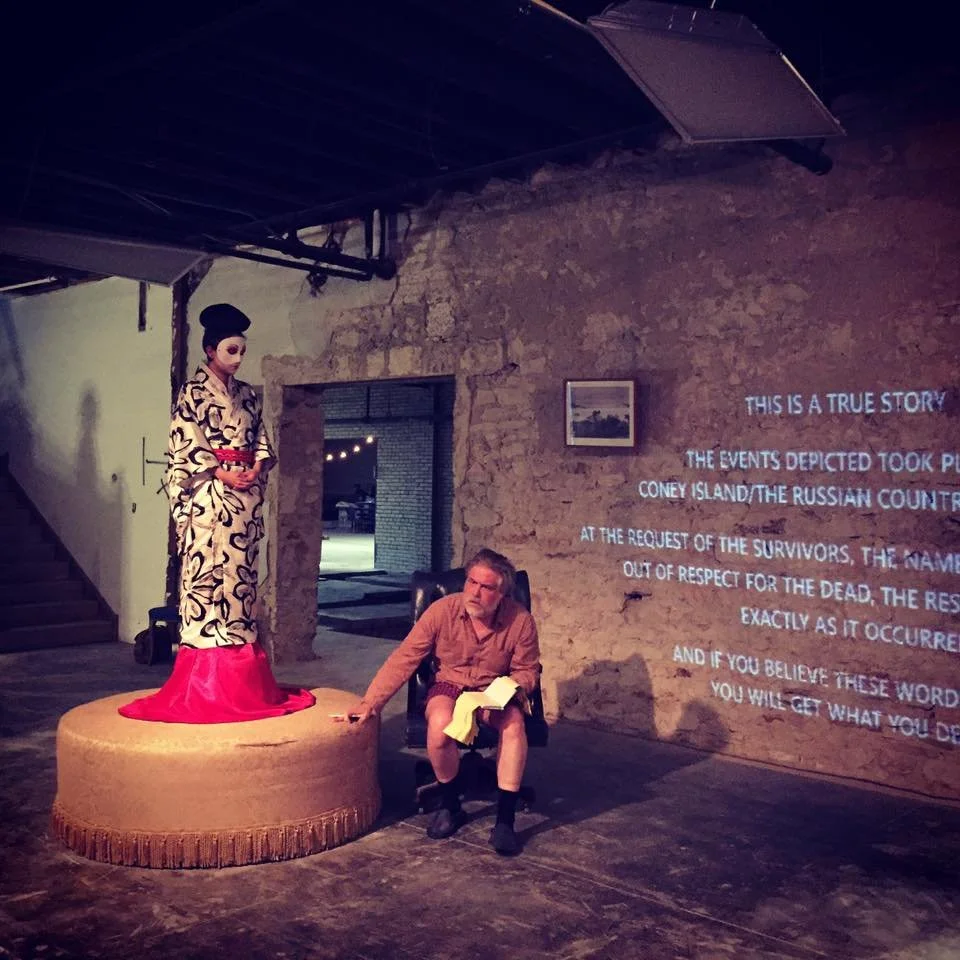
The Hotel Vanya, or A Metaphysical-Paradigm At The End of Everythingness, “At a location that is here and there and almost gone”, Austin, TX, 2016